12.05.2026 | 5 min read
Sarah Cunningham stepping down as Managing Director
Having grown the World Wellbeing Movement from pre-launch to significant impact, Sarah Cunningham will shortly be stepping down as Managing Director.In this self-penned blog, Sarah reflects on what has been achieved over the past four years, and shares how she will remain involved as Chair of the WWM’s Expert Group on Work Wellbeing and active co-lead author of the Work Wellbeing Playbook.
As I prepare to step down as Managing Director of the World Wellbeing Movement (WWM), I find myself reflecting on what an extraordinary four years this has been, and feeling deeply proud of what we have built together. Leading this organisation, alongside its distinguished co-founders, talented team, and global community of partners, has been such a privilege.
When co-founders, Prof Lord Richard Layard and Prof Jan-Emmanuel De Neve, invited me to lead the World Wellbeing Movement in 2022, they placed their trust in me to translate their vision into something real and impactful. To Richard and Jan, thank you for both the opportunity and your unwavering support every step of the way.
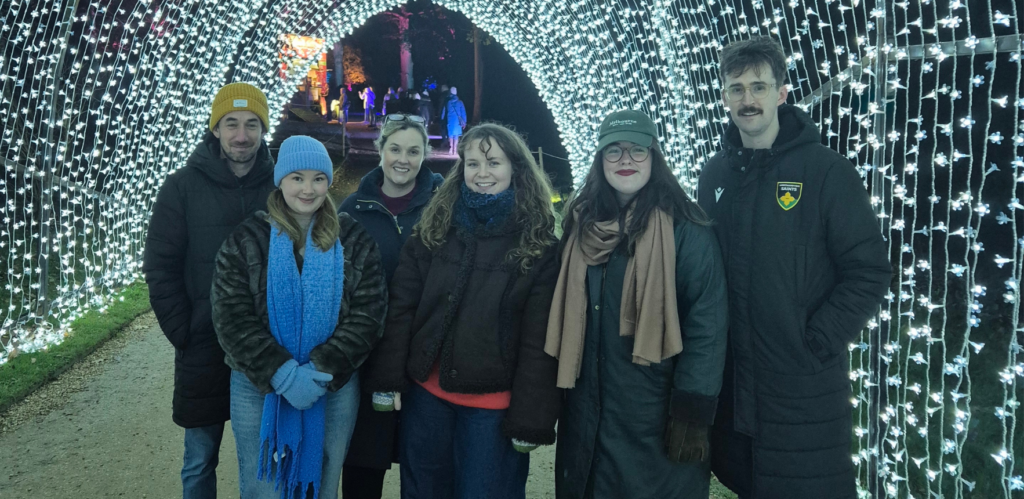
The World Wellbeing Movement team Holiday outing at Blenheim Palace, December 2025.
The heart of the World Wellbeing Movement has always been its people. To everyone who has been part of Team WWM, including Jonathan, Charlotte, Ben, Harriet, and Cathy, thank you. You have poured immense talent, expertise, and care into these formative years, and the organisation would not be what it is today without you. It was a proud moment to see this recognised externally when Team WWM received the ‘Social Impact’ award at the InsideOut Awards, alongside a ‘Behind the Scenes Champion’ award for Charlotte Day and a ‘Future Leader’ recognition for Jonathan Whitney.
The heart of the World Wellbeing Movement has always been its people. To everyone who has been part of Team WWM, including Jonathan, Charlotte, Ben, Harriet, and Cathy, thank you.
I am equally grateful to our colleagues at the Wellbeing Research Centre at the University of Oxford, our academic partner, for the invaluable research support they have provided over these past years. In partnership, we have translated academic insight into real-world impact, most notably through the Work Wellbeing Playbook, now used by organisations around the world to craft workplace wellbeing strategies grounded in evidence. The strong demand that led us to develop Work Wellbeing Playbook 2.0 reflects the growing appetite for practical, evidence-based guidance.
My thanks go to the full author team behind both editions, and in particular to Dr Cherise Regier, with whom I have the honour of serving as co-lead author, and to Dr William Fleming, whose expertise also contributed to the MindForward Alliance Thriving at Work Framework, developed in partnership. I am also grateful to Dr Maria Cotofan for authoring our UK Wellbeing Reports, which continue to bring stark statistics around ‘happiness poverty’ into the public policy conversation.
A significant milestone for the WWM was being granted registered charity status in 2024, reflecting the importance of the work we do for the public good. Our Board of Directors, who serve as trustees of the charity, have played a central role in its stewardship through this period of growth. I am deeply grateful to our Board members Richard, Jan, Barbara, Gus, Karen, LaFawn, and, more recently, Kate, for their wisdom, time, and generous counsel.
Alongside this, our Advisory Council has provided invaluable strategic insight, while our Expert Group on Work Wellbeing has ensured that our work remains grounded in real-world practice, enabling us to deliver meaningful impact in support of our charitable mission. My thanks to all members of both groups for the generosity of your time and insight.
We could not do this work for the public good without the generous support of our corporate and philanthropic partners, to whom I am deeply grateful. A significant step forward for the WWM was the appointment of our Head of Policy and Public Affairs, Ben Wealthy, just over 18 months ago. This senior role, made possible through the support of the Bloom Wellbeing Fund, has enabled us to extend our impact and strengthen our policy work. Since then, Ben has played a central role in supporting the re-establishment of the UK’s All-Party Parliamentary Group on Wellbeing Economics, helping to give wellbeing a formal place in UK Parliament.
Among the experiences I am most grateful for is the opportunity to have conceived and host the Working on Wellbeing podcast. Across three seasons and 26 episodes, I have had the privilege of sitting down with leading voices in wellbeing science and practice, from Prof Amy Edmondson on psychological safety, to Prof Robert Waldinger on the longest-running study of human happiness, to Prof Amanda Kirby on neuroinclusive workplaces. Many of my distinguished guests, including Alastair Campbell, Jen Fisher and Niall Breslin, have spoken candidly about their own mental health journeys and shared practical insights on recovery and resilience, as well as what business leaders and policymakers can do to improve wellbeing at scale. To every guest who has given their time, expertise, and honesty, thank you. I am also grateful to S&P Global for their support of seasons two and three of the podcast.
Four years has gone quickly. What has been built over that time is something I am deeply proud of, and it has been a privilege to lead the World Wellbeing Movement through its formative stage.
Four years has gone quickly. What has been built over that time is something I am deeply proud of, and it has been a privilege to lead the World Wellbeing Movement through its formative stage.
While I am stepping down, I am not stepping away completely. I will stay close, as Chair of the WWM Expert Group on Work Wellbeing and as an active co-author of the Work Wellbeing Playbook. And who knows, there might even be more episodes of the Working on Wellbeing podcast to come!
The work of the World Wellbeing Movement is only just beginning. The case for putting wellbeing at the heart of decision-making both in business and public policy has never been clearer. The evidence is strong, the tools exist, and the momentum is building.
Thank you for these four extraordinary years. Let’s put wellbeing first!