For business leaders
For business leaders
“Caring about the happiness of others, we find our own. Plato
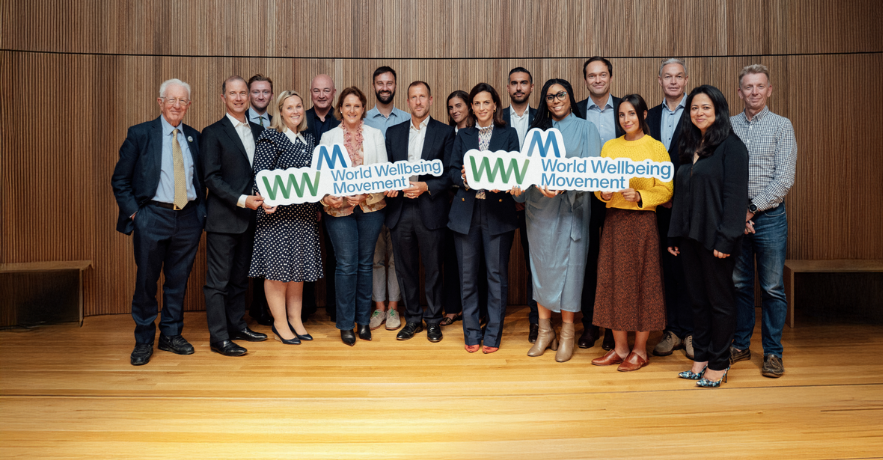
We are a coalition of like-minded global leaders from business, civil society, and academia that have come together to put wellbeing at the heart of decision-making.
Why support the WWM?
The World Wellbeing Movement would not be possible without the support of our members. As a not-for-profit organisation, every dollar of funding is used in the pursuit of our objectives.
Wellbeing pioneers
See your organisation recognised globally as a leader in advancing wellbeing.
A global network
Join a global network of leaders in business, policy, and academic research.
Change makers
Become part of a community that takes action, and creates momentum for positive change.
High-end research
Understand from leading academics and practitioners how to measure and improve wellbeing in your organisation.
Real-world insights
Advanced access to actionable evidence-informed insights to improve workplace wellbeing.
Public good
Supporting us in our goal of creating change for the public good by making our work publicly accessible.
The business case
Positive impact of improved employee wellbeing
Productivity
A one point increase in employee happiness leads to a 12% increase in productivity.
In the first field study of its kind, researchers from the Wellbeing Research Centre at the University of Oxford conducted a randomised control trial (RCT) with employees of BT call centres. By comparing self-reported employee wellbeing scores with key performance indicators, they found that a one point increase in employee happiness leads to, on average, a 12% increase in productivity (Bellet, De Neve, & Ward, 2023).
Recruitment
Workplaces with better wellbeing are 14% more likely to attract prospective talent.
A workplace wellbeing score that is either average or above average (as compared to low) increases the probability of jobseekers applying to available positions by 14.2%. This study provides the first causal evidence for workplaces with higher employee wellbeing being more attractive employers. Would-be employees are also, on average, willing to give up around 13% of their salary to work at a happier company (Ward, 2021).
Downside of poor employee wellbeing
Cost of unhappiness
Poor mental health is estimated to have cost UK employers up to £56bn in 2020-21.
A study by Deloitte estimated that the cost of poor mental health to UK employers was estimated to be up to £56bn in 2020-21 (Deloitte, 2022).
Employee attrition
Burned out employees are six times more likely to want to leave their current job.
A McKinsey Health Institute (MHI) survey in 15 countries found a quarter of employees experienced burnout symptoms in the previous year, with the biggest driver relating to a toxic workplace. The research further indicated that burned out employees are six times more likely to want to leave their current job (MHI, 2022).
The World Wellbeing Movement’s operating model
Connecting the dots
The World Wellbeing Movement is housed within the Wellbeing Research Centre at the University of Oxford, which also serves as its lead academic partner.
The World Wellbeing Movement is an impact organisation working at the intersection between academic experts, and decision-makers in both business and policy to translate evidence-informed wellbeing insights into real-world impact.